GETTING OHIO EMPLOYEES SAFELY BACK TO WORK
Personalized Managed Care That Goes Beyond the Claim
Your Ohio Managed Care Organization (MCO) should offer more than just claim support. At Sheakley UniComp, we create a proactive pathway to recovery that benefits both you and your employees. Our vast knowledge base allows us to facilitate high quality, effective medical care that you can rely on to get injured employees the care they deserve.
Improve Employee Experience and Retention Through Individualized Care Plans
When it comes to workers’ compensation claims, one of the most important factors in a successful outcome is ensuring injured employees receive the right care at the right time. Early intervention, appropriate treatment, and coordinated care help employees recover safely and confidently while reducing unnecessary delays. Our modern approach to managed care focuses on connecting injured workers with quality providers and individualized care plans that support recovery and a timely return to work.

STATEWIDE OHIO COVERAGE
Connecting Injured Workers to Care Across Ohio
ALL88 COUNTIES
Care Close to Home for Every Employee
From Cincinnati to Cleveland and every community in between, injured employees find in-network care near where they live and work.
Certified Since Ohio’s Program Began
Sheakley UniComp has been a BWC-certified Managed Care Organization since the state created the program in 1997.
Over
BWC-certified provider locations statewide, including 256 hospitals and 641 occupational medicine facilities.
Up to
%
Network savings below the BWC fee schedule.
How We Help
From Claim Management to Trend Reporting, Sheakley UniComp Covers Every Aspect of Workers' Comp

Proactive Medical Case Management
Aggressive claim management from the date of injury. Timely treatment promotes quicker recovery and a safe return to work.

Return-to-Work Strategies
Light duty job placement, field case management, and modified duty task lists get injured workers back on the job.

Client Relations Manager
Your personal consultant. Reviews your business needs and identifies programs that may reduce your costs.

Integrated Therapy Program
On-site and transitional therapy lets injured workers recover while remaining on the job.

Employer Disability Advisor
Board-certified physicians provide peer-to-peer contact with the treating physician to speed claim resolution.

Injury Trend Reporting
Identify injury frequency and type, compare against others in your industry, and coordinate prevention programs.
You’re In Good Company
Hear It Directly From Our Clients
As one of Ohio’s first certified Managed Care Organizations, it’s our goal to help employers get their injured workers back to work as quickly and safely as possible.
"We are incredibly grateful for our partnership with Sheakley. Their exceptional case management services have been instrumental in ensuring our employees receive the highest quality care."
Fallon L., Director of Human Resources, Education and Safety, Sisters of Charity of Cincinnati
Trusted by













Sheakley Unicomp
Choose Sheakley UniComp As Your Ohio MCO
New to Ohio? A new employer has 30 days to select an MCO. To select Sheakley UniComp, complete the enrollment form or call us at 888-743-2559 x7070.
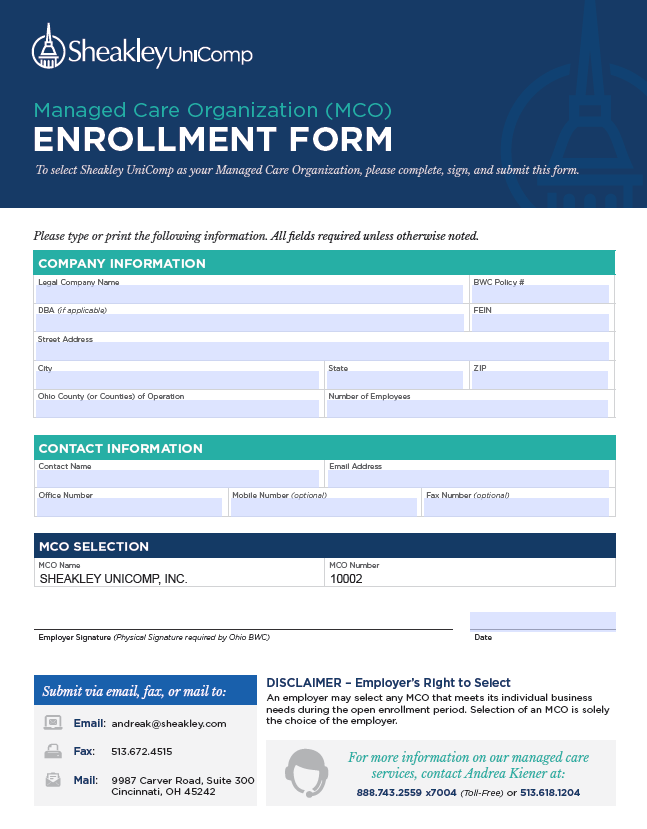
Complete and submit the fillable form to enroll.
FOR CLIENTS & PROVIDERS
WHAT TO DO IF AN INJURY OCCURS
Within 24 hours of an employee seeking medical treatment
Email the FROI, with the injured worker’s signature and any medical documentation, to unicompfroi@sheakley.com, or fax to 1-888-626-2667 or 1-513-326-8005.
AFTER YOU’VE TREATED A PATIENT
Check bill status and billing information
Providers can look up claim and payment details quickly and conveniently through UniComp Central.
For Injured Workers
Your Rights and Responsibilities.
As an injured worker, you have rights and responsibilities related to your worker’s compensation claim:
Injured Worker Rights
You have the right to:
- Be active in the care of your injury and how to get the care you need
- Be treated with courtesy and respect by the Sheakley UniComp, Inc staff
- Understand and be active in your care and case management plan
- Refuse care or case management services
- Choose and/or change your BWC provider when you want
- Be seen by a doctor in the case of an emergency
- Privacy of information regarding your health
- File an appeal or grievance if you do not agree with a decision made about your care
- Be informed of all choices you have when making a decision about your care
- Be notified of changes in your case management plan, including when it is closed
- Have end of life and advanced care directives honored, if given
Injured Worker Responsibilities
You have the responsibility to:
- Tell your doctors and other health care providers about your medical history
- Follow what your doctor and case manager tell you to do to get better
- For example, if you are given restrictions, make sure you follow them not only at work but at home/outside of work as well
- Ask questions about your care and your worker’s compensation claim
- Treat your providers and the Sheakley UniComp, Inc. staff with courtesy and respect
- Be active in the care of your injury
Frequently Asked Questions
Common questions from Ohio employers about choosing an MCO, reporting injuries, and getting injured employees back to work. Don’t see yours? Contact our team and we’ll help.
MCO Basics
What is a Managed Care Organization (MCO)?
An MCO is a private company contracted with the Ohio Bureau of Workers’ Compensation to medically manage the healthcare side of a workplace injury. They process your medical bills, coordinate treatments, and work on getting your employees healthy enough to return to work.
What does an MCO actually do for employers?
An MCO manages the medical portion of your workers’ compensation claims. They coordinate treatment, communicate with providers, review treatment requests, manage/pay medical bills, and help injured employees return to work safely and efficiently. A strong MCO partnership can improve claim outcomes, reduce lost workdays, and provide valuable support when workplace injuries occur.
How do MCOs help reduce costs?
MCOs help reduce workers’ compensation costs through proactive medical management. By coordinating care, reviewing treatment requests, monitoring recovery, and supporting return-to-work efforts, MCOs help injured employees recover safely and return to work sooner. This can reduce claim duration, lost workdays, and overall claim costs.
Why do I have to choose an MCO?
Every Ohio employer covered by the Ohio BWC must be assigned to a Managed Care Organization (MCO). MCOs coordinate medical treatment for workplace injuries, manage the medical aspects of workers’ compensation claims, and help employees return to work safely and efficiently. Choosing the right MCO allows you to partner with an organization that aligns with your company’s goals and provides the level of service and support you expect when a workplace injury occurs.
What happens if I don't choose an MCO?
Ohio employers are required to have an MCO. If a new employer does not select an MCO within the required timeframe, the Ohio Bureau of Workers’ Compensation will randomly assign one. Choosing your own MCO allows you to select the organization that best aligns with your service expectations and business needs.
How is the MCO paid?
MCO services are provided at no direct cost to Ohio employers. The Ohio Bureau of Workers’ Compensation (BWC) contracts with MCOs and pays them to manage the medical portion of workers’ compensation claims, coordinate care, and support return-to-work efforts. Employers choose the MCO that best meets their needs, but they do not receive a separate bill for MCO services. MCOs are paid based on the number of active claims managed.
Choosing and Changing your MCO
Can a new employer choose their MCO?
Yes. New Ohio employers are required to select an MCO after obtaining workers’ compensation coverage through the Ohio Bureau of Workers’ Compensation. Employers should review available MCO options and choose the organization that best supports their employees and return-to-work objectives. If an MCO is not selected, BWC may assign one.
How do I choose an MCO?
Employers should evaluate an MCO based on its performance, service, provider network, and return-to-work results. Ohio BWC provides an MCO Report Card that compares MCO performance across several key metrics. The right MCO can help ensure injured employees receive quality care while minimizing lost workdays and supporting a successful return to work.
What should I look for when choosing an MCO?
When choosing an MCO, employers should evaluate the organization’s return-to-work results, medical management performance, provider network, customer service, and overall responsiveness. Ohio BWC’s MCO Report Card can help compare MCOs based on key performance measures. The right MCO should provide proactive support, strong communication, and a proven ability to help injured employees receive quality care and return to work safely.
What are the benefits of having a good MCO?
A high-performing MCO can have a significant impact on both employee outcomes and claim costs. Benefits may include:
- Faster return-to-work outcomes
- Timely and appropriate medical treatment
- Improved communication among all parties involved in the claim
- Reduced lost workdays
- Better medical management
- More efficient claim coordination
- Improved overall claim outcomes
An effective MCO helps injured employees recover safely while minimizing disruptions to your workforce and operations.
Can I change my MCO?
Yes. Ohio employers have the opportunity to change their Managed Care Organization (MCO) during the Ohio BWC’s MCO Open Enrollment period. Outside of open enrollment, employers typically remain with their current MCO unless a special circumstance applies. Reviewing your MCO’s performance, service, return-to-work results, and provider network can help you determine whether a change would benefit your organization.
What is the MCO Report Card?
The Ohio Bureau of Workers’ Compensation (BWC) MCO Report Card is a tool that allows employers to compare the performance of Ohio’s MCOs. The report card evaluates factors such as return-to-work outcomes, service timeliness, medical management performance, and overall claim management effectiveness. Employers can use this information to make informed decisions when selecting an MCO.
BWC, MCO, and TPA
What is the difference between a Third-Party Administrator and a Managed Care Organization in Ohio?
For Ohio employers, an MCO and TPA often work together. The MCO focuses on quality medical care and return-to-work outcomes, while the TPA focuses on controlling costs, maximizing savings opportunities, and protecting the employer’s interests.
What is the difference between Bureau of Workers' Compensation and an MCO?
Bureau of Workers’ Compensation (BWC): The BWC is a government agency that handles the legal status of your claim, decides if the claim is allowed, and issues your financial compensation or disability payments.
Managed Care Organization (MCO): An MCO is a private company contracted with the BWC to medically manage the healthcare side of the claim. They process your medical bills, coordinate treatments, and work on getting your employees healthy enough to return to work.
What is the difference between BWC, MCO, and TPA?
BWC, MCO, and TPA each play a different role in Ohio workers’ compensation. The BWC administers the state’s workers’ compensation system, the MCO manages the medical side of workplace injury claims, and the TPA helps employers control costs, navigate claims, and maximize workers’ compensation program savings. While every Ohio employer must have a BWC policy and an MCO, partnering with a TPA is optional.
Do I have to have an MCO and TPA?
Ohio state-funded employers are required to have an MCO, but hiring a TPA is optional. An MCO manages medical treatment and return-to-work activities, while a TPA provides employer-focused services such as claims consulting, hearing representation, cost-control strategies, and workers’ compensation program management. Many employers choose to partner with both for comprehensive support.
Injuries and Claims
How fast must injuries be reported?
Who files a workers’ compensation claim?
A workers’ compensation claim can be filed by the injured worker, employer, medical provider/physician’s office, or MCO. Once the injury is reported through a First Report of Injury (FROI), BWC reviews the claim and the MCO begins coordinating the medical aspects of care.
What is a First Report of Injury (FROI)?
A First Report of Injury (FROI) is the document used to officially report a workplace injury and initiate a workers’ compensation claim. The FROI includes basic information about the employee, employer, injury, and incident. It may be filed by the injured worker, employer, medical provider, or MCO. Once submitted, the claim can be reviewed and processed through Ohio’s workers’ compensation system.
What happens when an employee is injured?
When an employee is injured, the injury is reported and a workers’ compensation claim is filed with BWC. The MCO then coordinates medical treatment, communicates with providers, manages treatment requests, and supports return-to-work efforts. Throughout the process, the employer, injured worker, MCO, and BWC work together to help the employee recover and return to work safely.
What should I do immediately after an employee is injured?
If an employee is injured on the job, your first priority is ensuring they receive appropriate medical care. Once the employee’s immediate needs have been addressed, document the incident, report the injury as soon as possible, notify your MCO, and begin discussing return-to-work options if work restrictions are anticipated. Prompt reporting and early intervention can help improve recovery outcomes, reduce lost workdays, and support a smoother claims process.
Employer Responsibilities
What are employer responsibilities in the process?
An employer’s role is to support the injured worker’s recovery while helping facilitate a safe return to work. Responsibilities include reporting injuries promptly, maintaining communication with the employee, providing claim information, coordinating with the MCO and medical providers, offering transitional work when available, and participating in the claims process as needed.
What records must employers keep?
Employers should maintain records related to the injury, claim, medical treatment, payroll, and return-to-work activities. Keeping complete documentation helps support claim management, BWC compliance, hearing preparation, and workers’ compensation cost-control efforts.
Do I need to post workers’ comp information?
Yes. Ohio employers are required to post proof of workers’ compensation coverage where employees can easily see it or access it electronically. The notice confirms that the employer maintains workers’ compensation coverage and informs employees of their rights if a workplace injury occurs.
Return to Work
What is a "Return to Work" plan?
A Return-to-Work Plan is a roadmap for helping an injured employee safely return to work after an injury. It outlines any medical restrictions, modified duties, and accommodations needed during recovery, while providing a clear path back to the employee’s regular job responsibilities.
What is an employer’s role in return-to-work programs?
As an employer, your role is to help injured employees return to work safely and productively. This includes maintaining communication, evaluating work restrictions, identifying modified-duty opportunities, and collaborating with your MCO and medical providers throughout the recovery process. A successful return-to-work program can improve outcomes for employees while reducing lost time and claim costs.
How does an MCO help injured employees return to work?
MCOs play a key role in facilitating safe and timely return-to-work outcomes. They communicate with healthcare providers, monitor medical progress, coordinate treatment plans, review work restrictions, and work with employers to identify appropriate transitional or modified-duty opportunities. By keeping all parties informed and focused on recovery goals, MCOs help injured employees return to productive work as soon as medically appropriate.
What happens if an employee refuses modified-duty work?
If an employer offers suitable modified-duty or transitional work that is within the employee’s documented medical restrictions, and the employee refuses the offer, it may affect the employee’s eligibility for certain workers’ compensation benefits. Employers should work closely with their MCO, TPA, and the treating physician to ensure any job offer accurately reflects the employee’s restrictions and is properly documented.
What is a transitional work program?
A Transitional Work Program allows injured employees to return to work in a temporary modified-duty position while they recover. These programs help employees remain productive, support a safe return to work, reduce lost workdays, and can help control workers’ compensation costs by shortening the duration of claims.